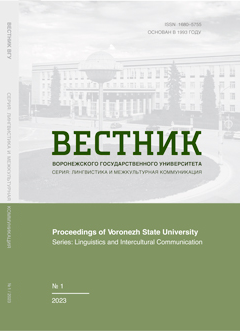
The evolution of the study of the concept: from linguoculturology and cognitive science to psycholinguistics. Dynamics and integration in modern science
DOI:
https://doi.org/10.17308/lic/1680-5755/2026/3/6-12Keywords:
concept, cultural linguistics, cognitive linguistics, psycholinguistics, discourse, variabilityAbstract
The article is devoted to a comprehensive analysis of the concept of a concept as a key category of modern linguistics, acting as a link between language, consciousness and culture. The evolution of the study of the concept is traced, three leading research paradigms are distinguished: linguocultural, linguocognitive (cognitive-linguistic) and psycholinguistic.
The linguocultural approach focuses on historicism, cultural specificity and the value component of the concept, reflecting the identity of the linguistic and cultural community. The linguocognitive approach focuses on the concept as the basic unit of knowledge organization in individual and collective consciousness, resulting from the processes of categorization and conceptualization, explores the structure of the concept, including the conceptual core, figurative and value components, as well as the cognitive mechanisms of its formation. The psycholinguistic approach studies the concept as a dynamic formation in the individual consciousness, examines the processes of its formation, storage and actualization in speech activity.
Special attention is paid to the current stage of understanding the concept, characterized by a distinct tendency to synthesize existing approaches, according to which the concept is increasingly understood as a dynamic, multidimensional and biocultural entity existing at the junction of individual and collective, cognitive and cultural, verbal and non-verbal. The emphasis shifts from describing the static structure of a concept to studying the process of conceptualization itself as meaning generation in discourse and activity. Its fundamental variability, discursive conditionality, and multimodality of representation, including gestures, images, and bodily practices, are emphasized. It is noted that a comprehensive study of such a complex phenomenon requires integrative theoretical models and complex techniques combining corpus, experimental (including neuro-linguistic), ethnographic methods and discourse analysis.
The prospects for the development of concept theory are seen in the further development of synthetic approaches capable of organically combining the achievements of linguoculturology, cognitive linguistics and psycholinguistics to create an integrated model of this fundamental phenomenon underlying human thinking, cognition and communication.
References
1. Stepanov YU.S. Konstanty: Slovar′ russkoy kul′tury. Opyt issledovaniya [Constants: Dictionary of Russian Culture. Research experience]. – M., 1997. (In Russ.)
2. Karasik V.I. Lingvokul′turnyy kontsept kak yedinitsa issledovaniya [Linguistic and cultural concept as a unit of research]// Yazyk, soznaniye, kommunikatsiya: Sb. st. / Otv. red. V.V. Krasnykh, A.I. Izotov. – M., 2021. – S. 45-62. (In Russ.)
3. Zalevskaya A.A. Psikholingvisticheskiy podkhod k probleme kontsepta [Psycholinguistic approach to the problem of the concept]// Metodologicheskiye problemy kognitivnoy lingvistiki: Nauchnoye izdaniye / Pod red. I.A. Sternina. — Voronezh: Voronezh. gos. un-t, 2001. — S. 35-40. (In Russ.)
4. Popova Z.D., Sternin I.A. Aktual′nyye problemy kognitivnoy lingvistiki i lingvokontseptologii [Current problems of cognitive linguistics and linguistic conceptology]. – Voronezh, 2022. (In Russ.)
5. Alefirenko N.F. Kontsept v fokuse kognitivno-diskursivnoy paradigmy [The concept in the focus of the cognitive-discursive paradigm]// Filologicheskiye nauki. Voprosy teorii i praktiki. – 2022. – T. 15, № 1. – S. 13-18. (In Russ.)
6. Vorkachev S.G. Lingvokontseptologiya: status distsipliny i napravleniya issledovaniy [Linguoconceptology: the status of the discipline and research areas]// Vestnik Volgogradskogo gosudarstvennogo universiteta. Seriya 2: Yazykoznaniye. – 2020. – T. 19, № 1. – S. 6-18. (In Russ.)
7. Karasik V.I. Kul′turnyye dominanty v yazyke [Cultural dominants in language]// Karasik V.I. Yazykovyye klyuchi. – M., 2009. – S. 166-205. (In Russ.)
8. Kubryakova E.S. O ponyatiyakh mesta, predmeta i prostranstva [About the concepts of place, object and space]// Kubryakova E.S. Yazyk i znaniye: Na puti polucheniya znaniy o yazyke: Chasti rechi s kognitivnoy tochki zreniya. Rol′ yazyka v poznanii mira. – M., 2004. – S. 581-606. (In Russ.)
9. Babushkin A.P. Tipy kontseptov v leksiko-frazeologicheskoy semantike yazyka [Types of concepts in the lexical and phraseological semantics of language.]. – Voronezh, 1996. (In Russ.)
10. Pimenova M.V. Evolyutsiya kontseptov v epokhu globalizatsii: lingvokul′turnyy aspekt [Evolution of concepts in the era of globalization: linguistic and cultural aspect]. – Kemerovo, 2020. (In Russ.)
11. Slyshkin G.G. Kontseptosfera tsifrovogo diskursa: novyye ob′′yekty i metody [The conceptual sphere of digital discourse: new objects and methods]// Voprosy psikholingvistiki. – 2023. – № 1 (55). – S. 78-92. (In Russ.)
12. Kravchenko A.V. Znak, znacheniye, znaniye: Ocherk kognitivnoy filosofii yazyka.[ Sign, meaning, knowledge: An essay on the cognitive philosophy of language] — Irkutsk: Izd-vo IGLU, 2001. (In Russ.)
13. Perfil′yeva N.V. Kontsept "terpeniye" v russkoy yazykovoy kartine mira [The concept of "patience" in the Russian linguistic picture of the world] // Vestnik Kemerovskogo gosudarstvennogo universiteta. 2014. № 4-2 (60). S. 159–163. (In Russ.)
14. Lakoff Dzh. Zhenshchiny, ogon′ i opasnyye veshchi: Chto kategorii yazyka govoryat nam o myshlenii [Women, fire, and dangerous things: What the categories of language tell us about thinking]/ Per. s angl. – M., 2004. (In Russ.)
15. Myagkova E.YU. Kognitivnyye osnovaniya issledovaniya emotsional′nogo leksikona [Cognitive foundations of emotional lexicon research /]// Voprosy kognitivnoy lingvistiki. 2004. № 1. S. 55-64. (In Russ.)
16. Yevsyukova T.V. Lingvokognitivnoye modelirovaniye kontsepta: metodologiya i metody issledovaniya [Linguocognitive modeling of a concept: methodology and research methods]// Vestnik Omskogo universiteta. Seriya «Filologiya». 2011. № 4. S. 174–181. (In Russ.)
17. Ivanova S.V. Osnovy kognitivnoy lingvistiki. [undamentals of cognitive linguistics]— SPb.: Filologicheskiy fakul′tet SPbGU; M.: Akademiya, 2010. (In Russ.)
18. Krasavskiy N.A. Etnokul′turnaya spetsifika emotsional′nykh kontseptov [The ethnocultural specificity of emotional concepts]// Izvestiya Volgogradskogo gosudarstvennogo pedagogicheskogo universiteta. Ser. Filologicheskiye nauki. 2004. № 1 (6). S. 72-78. (In Russ.)
19. Gudkov D.B. Teoriya i praktika mezhkul′turnoy kommunikatsii. [Theory and practice of intercultural communication.] — M.: Gnozis, 2003. (In Russ.)
20. Kontseptosfera russkogo yazyka: klyuchevyye kontsepty i ikh reprezentatsii v yazyke i rechi (na materiale leksiki, frazeologii, paremiologii) [The conceptual sphere of the Russian language: key concepts and their representations in language and speech (based on vocabulary, phraseology, and paremiology)] / pod red. L.G. Babenko– Yekaterinburg, 2017. (In Russ.)
21. Bolotnova N.S. Filologicheskiy analiz teksta: ucheb. Posobiye [Philological analysis of the text: textbook. stipend]. — M.: Flinta: Nauka, 2007. (In Russ.
22. Shmelev A.D. Kontsept OBSHCHENIE v tsifrovuyu epokhu: novyye konteksty i smysly // Kommunikativnyye issledovaniya [The concept OF COMMUNICATION in the digital age: new contexts and meanings]. – 2023. – T. 10, № 1. – S. 56-72. (In Russ.)
23. Larina T.V. Kategoriya vezhlivosti i stil′ kommunikatsii: Sopostavleniye angliyskikh i russkikh lingvokul′turnykh traditsiy. [Category of politeness and style of communication: Comparison of English and Russian linguistic and cultural traditions] — M.: Rukopisnyye pamyatniki Drevney Rusi, 2009.
24. Krasnykh V.V. Kontsepty "svoy" i "chuzhoy" v usloviyakh tsifrovoy kommunikatsii[Concepts of "friend" and "stranger" in the context of digital communication] // Yazyk i kul′tura v epokhu tsifrovizatsii: Sb. nauch. tr. – M., 2024. – S. 112-128. (In Russ.)
25. Paducheva E.V. Aspekty semantiki i pragmatiki vyskazyvaniya: svyaz′ s kontseptual′noy strukturoy [Aspects of semantics and pragmatics of utterance: relation to the conceptual structure]. – M., 2024. (In Russ.)
26. Evans V. Cognitive Linguistics: New Directions in the Study of Conceptual Structure. – Berlin, 2024.
27. Babenko L.G., Kazarin YU.V. Kontsept DOSTOINSTVO v russkoy yazykovoy kartine mira: leksika, frazeologiya, diskurs [The concept of DIGNITY in the Russian linguistic worldview: vocabulary, phraseology, discourse]. – Yekaterinburg, 2021. (In Russ.)